Sometimes I worry if anyone reads anymore. I work alongside a lot of university students, so I realize their time for reading is filled with mandatory pages of text books. But most of them confess they’ve never been “a reader.” Of course, this is a disappointment to me, who wants to discuss favourite authors, most compelling characters, and best genres. The mental vacations provided by story aren’t just for fun and relaxation. They expand our ability to see things beyond our own experiences. Immersing ourselves in a narrative with a protagonist who is vastly different from ourselves enables us to simultaneously see the world through our own eyes, and theirs. It gives us a breadth of understanding we cannot get anywhere else.
I hear you asking, “What about movies or TV shows?” And these are important too. But, compared to reading, TV provides only a fraction of potential critical thinking growth. When we watch something on a screen, it is someone else’s idea of what that story looked like. And it can explore themes and complex concepts. But it doesn’t engage with our inner self in the way the characters in a book do. The intimate act of imagination that is engaged when we picture a story while we read, connects us to the characters and their struggles in a unique way. It is the story, but it is also us. We have full creative control. This means, in a way, each reader is in the story. Every building, field, floppy hat, and hopping rabbit is a reflection – a compilation – of the reader’s own self and their understanding of the world. Because of this, every incident in the story has greater potential to impact and engage the reader.
Over the last few years, I’ve been using reading as a healing practice. One of the interesting things about us, as humans, is that we can see inconsistencies in others that we are blind to in ourselves. We can pretty easily spot problem-ideas in others, while clutching tightly to our own harmful habits. Usually we are entirely unaware of the connection between our habit and our problem. The distance needed to find healthy perspective for ourselves must be combined with an intimate understanding of our own life – the details of our own story. That’s why distance alone isn’t enough (and why your meddling relative, who has the distance, can’t give helpful advice.) When we read a story, we bring our whole experience with us. And we receive a perspective that isn’t our own. When I read about a boy who is grieving the loss of his mother. I feel empathy for him. But I also unlock grief in myself. I can put on these “water wings” of fictional grief to keep me afloat as I explore the depths of my own hurting heart. Things that are too scary, too dangerous to explore become safer when I’m projecting my unwanted feelings onto a fictional character. I can “trick myself” into dealing with feelings I’ve been avoiding. And because every part of the story is simultaneously separate from me and part of me, I can have both distance and connection.
When we read or listen to stories, we are free to explore dangerous ideas in safety. No one gets hurt if all the characters are fictional. For this practice, I recommend paper books, even though I’m also a lover of audio books. But when I am doing the reading, I can more easily pause and reflect. I can let my mind wander and explore every idea that the story digs up. I can flip back a page or two if my imagination has taken me backwards in the story. Reading for myself provides freedom to sneak myself into the ideas, trying them on like clothes, tossing the ones that don’t quite fit, and keeping some to bring into my real life.
I’ve dedicated these last few years to healing the emotional gashes and deep wounds of childhood trauma. Here, I find myself in need of unbelievable amounts of time. Time constrained by nothing. Time to reflect and sort. But this is scary and exhausting and often I fill up the time with projects and other good things – an avoidance tactic. When I read, the story lures me in while also providing plenty of time for reflection. I more easily feel compassion for the little girl in the story than for little-girl-me. But, upon reflection, she is me. Every bit of compassion I feel for a fictional character is actual, true compassion. The feelings I experience as I read, aren’t fiction. They’re real. And the characters in the story are at least partly me. I’ve brought myself to the story as I’ve pictured it. So each time I feel something kind toward a character, it is toward me too. This is how I’m accessing self-compassion, grief, anger, and healthy rage. It feels safe, because I know it’s just a book. But my inner self knows it’s so much more than that.
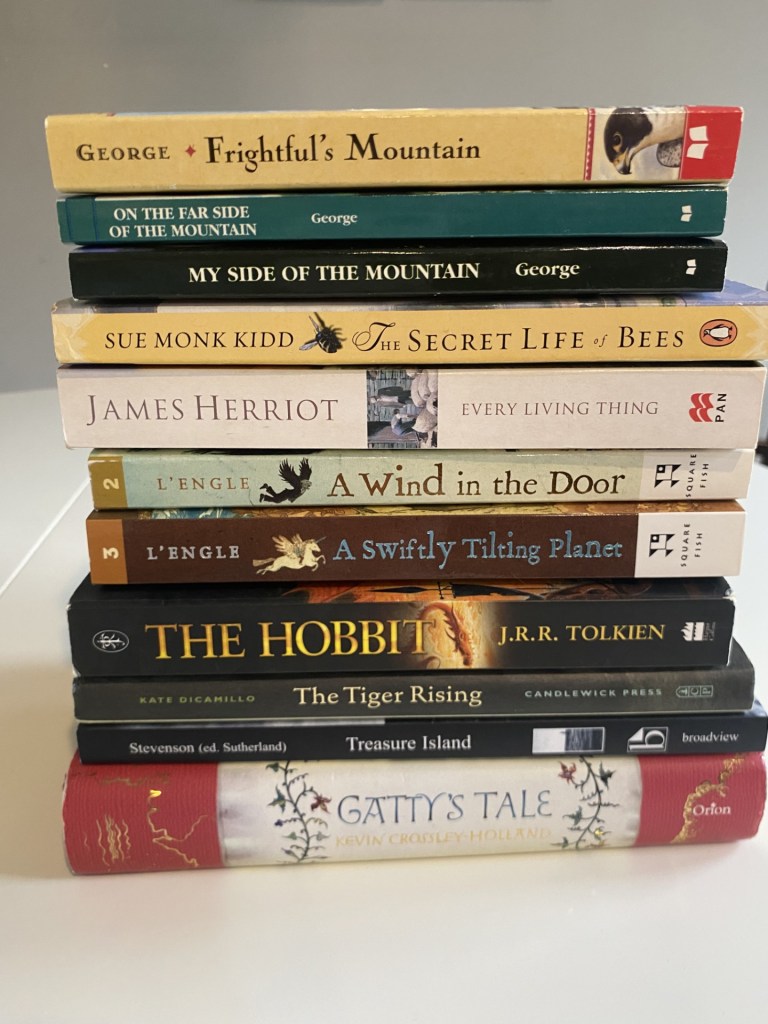
While all this is true about reading in general, I’ve found one particular genre to be most beneficial to my own healing and personal growth. Maybe it’s because I need to reconnect with my child-self as I heal these wounds, but books written for older children create the ideal conditions for this healing practice. My favourite authors include Kate DiCamillo, Madelaine L’Engle, Jean Craighead George, Kevin Crossley Holland, and Kimberly Brubaker Bradley.
A final appeal: If you have children in your life, of any age, I beg you to impart to them the joy of reading! Do not force them to read – this has short-term success, but long-term failure. Help them to find books they love. Any books – even comic books! And read with them. Read to them. One of my favourite reading memories is being read to. My mother read us books when I was young – books that were just a little beyond our range. And my grade six teacher, Mr. Bates, read to us too. It was the best part of the week. I still remember the magic of those stories.
In this AI world, it’s easy to distract ourselves one hundred percent of the time. We can run from shiny thing to shiny thing. We can surround ourselves with ideas and ideologies that match our own – never listening to another challenging thought for the rest of our lives. We can put all our effort into creating a cohesive façade. Or we can leave the outside for a while, with its competing voices and opinions. The expectations and admiration (or disapproval) of people who don’t even know us can be ignored as we step into the pages of a book. Truly alone, with no one watching, influencing, or taking notes, we are free to think our own thoughts and explore our own selves. Way back in elementary school, while I read “Charlotte’s Web” and dreamed of a spider who truly saw me the way Charlotte saw Wilbur, I never imagined a world where reading would become an act of political resistance. I never anticipated the avalanche of competition for my attention, alignment, and consent that threatens to co-opt even my own thoughts. Escape inside a book. Take your thoughts back. Be radically yourself.
 Something Deeper
Leave a comment